"Bachelor Brothers' Bed and Breakfast"

Bachelor Brothers' Bed and Breakfast by Bill Richardson

Finally, a Canadian book that isn't all darkness and angst and swearing. Ok there are a couple of swear words but overall this is a wonderful book. 

Hector and Virgil (who in my mind is the spitting image of the authour) are middle-aged twin brothers who have turned the house they grew up in into a bed and breakfast on Canada's west coast. The brothers are book lovers who see their home as a retreat for readers. Their guests are welcome to use the brothers' well-stocked library or to bring their own books with them. They cater to people like themselves, the "gentle and bookish and ever so slightly confused". That description alone had me hooked before I even started reading.

There is no plot, just a casual revealing of the brother's personalities and personal lives and the daily routines of the B&B. I have no objection to a good plot, but a book that is character driven has a much better chance of ending up on my "favorite reads" list and this is completely character driven. These endearing and oh-so-humanly flawed brothers move quietly into your world and make you wish they and their reader's retreat were real.

The chapters are written alternately by Hector and Virgil with letters from guests in between. Hector and Virgil write about their lives as innkeepers, their pasts and each other. The guest's letters tell their own stories and fill in details about the setting and the experience of being the brother's guests.

The lovely old house, the surroundings and the simple lifestyle the brothers offer their guests is nothing short of delicious. Reading the book is getting away for a quiet weekend, relaxing and comforting with enough humour to keep it fresh. Amazingly (because it happens often with books like this) it never becomes trite or even worse, cute. The brothers are quite realistic and that makes them all the more appealing.

The cover says "This quiet charmer is a bibliophiles delight" and that's exactly what it is. Other cover quotes say "a funny, cozy tale" and "a whimsically gentle fiction". I couldn't argue with those descriptions either, though the word "cozy" is dangerously close to "cute" and is recklessly overused in describing fiction. I love this book and I love it's witty, intelligent language. I was sorry to come to the last chapter but fortunately there is a sequel. It's called "Bachelor Brothers' Bed and Breakfast Pillow Book". A somewhat odd title, but hopefully it will be as good as this one was.

"Up In The Old Hotel"

Up In The Old Hotel by Joseph Mitchell

There's a lot of reading in this book and very good reading it is. Joseph Mitchell was a reporter in New York city during the 1930's and 40's so he knows how to tell a story; "Up In The Old Hotel" contains 37 of them. It takes a while to get through this book but it's pleasant reading and interesting stories so I don't think you'll mind the time.

The people in these stories are (for the most) real. They are the everyday people he got to know on the streets and in the diners and taverns of the city. There are many of them, so I'll just highlight some that stood out to me.

First, meet the Rev. Mr. James Jefferson Davis Hall, a street preacher who doesn't approve of soda fountains, dry-cleaners or modern women. "They've gone hog-proud and hog-wild. Wearing britches, wearing uniforms, straining their joints for generations to come with high-heeled shoes...their mouths smeared and smiddled and smoodled with paint, and their cheeks and their fingernails." The Reverend spends his days answering calls - he gives out his phone number and invites people in trouble to call him - and his nights walking Broadway, standing in the doorways of bars and preaching the consequences of drinking.

Then there's Jane Barnell, the bearded lady who began her career at the age of four, when she was given away to a traveling circus. She's had four husbands and in public wears a veil and a scarf around her neck to hide the beard.

Mazie P. Gordon is the "bossy yellow-haired blonde" who works the sidewalk ticket booth at a movie theater seven days a week from 9 am to 11 pm. She knows everybody and hears all the neighbourhood gossip. After work at night she walks the bowry handing out cakes of soap and change to people who need them.

And there's Phillipa, a 9 year old girl with an IQ of 185 who has been writing music since she was three years old, and John Smith, who writes big cheques and  gives them out to people who are nice to him, untroubled by the fact that he has no money at all.

One of my favourites is Arthur Samuel Colbourn, head of the Anti-Profanity League. Arthur, know as the "No-Swear Man" has handed out over six million cards asking "Please do not swear, nor use obscene or profane language. These cards are for distribution. Send for some - they are free. "His address is included on the card.

One story, called "A Mess Of Clams" is about the day he went out with a "buy-boat" off Long Island that came back carrying 145 bushels of clams destined for various markets and restaurants in the city. Another story is about the KKK, and another about the rodents that live in and around the city.

One story was very different. It was a sad account of a lonely man living in a furnished room. Short, and unique in that the authour wasn't involved in the story in any way, it had a completely different feel, like fiction. Mitchell does say in the introduction that though most of the book is true, some is fictional. I don't think it will matter to you when you're reading, because in the end it's all just good. 

I recommend this one to anyone who's looking for something interesting to read; it's not a page-turner so if that's what you like it may not be for you.

Favourite quote: 
                 "...it takes almost a lifetime to learn how to do a thing simply."

"Bay of Spirits - A Love Story"

Bay of Spirits by Farley Mowat

Another great story from a master story-teller, this one subtitled "A Love Story". It's the story of his first meeting with a beautiful woman named Claire and how their feelings for each other developed, but it is another love story too, of his years living in and exploring the outports of Newfoundland. His appreciation for the people, waters and wildlife of Newfoundland bring this story to vivid life.

Farley Mowat can capture the flavour of a place and it's people beautifully. A picture may to be worth a thousand words, but with just a few lines Mowat breathes life into a place like most pictures couldn't. It's an amazing gift he has.

Speaking of pictures, Bay of Spirits contains some wonderful shots showing a way of life that is mostly gone now. There are beautiful harbours with square wooden houses sitting precariously on the surrounding rock, fishing boats and wharves that look like they've been there forever, whales, dogs and people. It's the people that got to me, the faces, weathered and lined and real; amazing people who built lives out of little more than rock and water and were satisfied with what they had.

There are so many stories in this book: names, places and history, a wealth of information and experience that brings the reader so close to being there you can almost smell it. The hospitable nature of the people and communities all along the Newfoundland coast took the authour into the houses and personal lives of families who were willing and eager to share what they had. Over countless meals of fish and bread, boiled dinners, cups of tea and glasses of rum, people's stories were told and friendships formed. These are priceless glimpses into what it means to be a Newfoundlander and though I was born and raised in another east coast province, the stories gave me a very satisfying sense of place and roots.

There were aspects of the book I didn't find as interesting as the people stories; I learned far more than I ever wanted to know about boats and fishing. I couldn't even begin to sort out the various watercraft mentioned: schooners, skiffs, ships, whalers, motor launchers, herring seiners, steamers, smacks, longliners, longboats, motor boats, destroyers, draggers, dinghies and dories. And as confusing as it got trying to figure out these things they were putting in the water, some of what they were taking out of the water also gave me pause: cod, haddock, herring, lobster, dogfish, wolf fish, lumpfish, sculpins, redfish, squid, flatfish, minnows, blue mussels, horse mussels, moon snails, rock crab and scarlet mud worms. Eww.

Several stories highlight Mowat's well known concern for animals of all varieties. On a storm-tossed ship he finds a dog left caged and unattended on deck, making sure the dog is fed and finding a safer place for him to ride out the storm. When whales are stranded in a harbour and the local people make sport of slaughtering them, he is moved to tears. In another incident, the community gathers and gleefully fires bullets into a stranded whale, stopping only when they run out of ammunition. Mowat is stunned and horrified: "It was beyond me even to imagine the mentality of men who would amuse themselves filling such a majestic creature full of bullets."

As the subtitle indicates, this is also the love story of Farley Mowat and Claire Wheeler. This beautiful girl steps onto his boat and with one smile, in his own words, "I was lost". He writes about making love on a deserted beach and romantic nights aboard his boat. It's a sweet love story.....until he reveals that he is a married man with two small sons. In a world where this happens every day it's not so shocking I guess, but it is a little bit shocking (isn't it?) that he doesn't mention having any qualms about it. He doesn't try to fight his feelings for Claire, but, pardon the pun, jumps right in. As he tells the story of their developing romance it feels as though we are meant to celebrate with him this finding of the love of his life. The only time he expresses any concern about his family is when it's time to go home and tell them he's leaving them for someone else.

Normally, of course, this would be none of my business. But here's the thing. A writer has to give his readers a reason to believe what he's telling them. What he reveals about himself helps you decide if you should trust the theories, philosophies and stories he's asking you to accept. Here, he's asking us to accept that he has a deep compassion for wildlife while he shows very little compassion for his own family. His apparent lack of feeling for his wife and children, his children for pete's sake, leaves the reader with the uncomfortable suspicion that he may not be as compassionate as he would have you believe. I'm not saying he had no compassion for his family, but he has chosen to express none here and that's all a reader has from which to form conclusions.

I love his writing style and admire his amazing skill as a story-teller, and I do recommend the book. But I need to be able to trust that true stories are true and I've got questions now, so I guess that leaves me not quite as firm a fan as I was before this book.
"Christmas On Jane Street"

Christmas On Jane Street by Billy Romp, with Wanda Urbanska

This is a nice little holiday read, perfect for when you need a quiet hour with a cup of tea in the midst of the all the Christmas chaos. I have a few of these small Christmas books that I like to re-read every year, but this one is new to me. The title was vaguely familiar though and I'm wondering if there might have been a tv movie with the same name. It's a pretty good plot for a holiday movie.

"Christmas On Jane Street" is a true story, and that always makes things a little more interesting, but the writing in this one was lacking a certain something that might keep it off my "favorites" list. I find I'm sometimes disappointed with stories that are told "with" an authour who is helping get it down on paper. They feel a little stiff to me.

Favorite or not, it's still a good story with all the requisite elements for a satisfying Christmas story: family relationships strained and restored, friendly neighbours coming to each others aid and children testing the boundaries and spreading their wings. It all adds up to a low level of sappiness that is more than tolerable in a Christmas story. If you can watch "It's A Wonderful Life" with it's off the charts sap level and enjoy it, you'll be fine with "Christmas On Jane Street".

The corner of Jane Street and Eighth in New York City is where Billy Romp, his wife and three children set up their Christmas tree stand every year. They live on the tree lot in a tiny camper from Thanksgiving to Christmas Eve and become part of the neighbourhood where they are welcomed and taken care of by local residents and shop owners. This is the best part of the story to me. It's reassuring, life-affirming to read how generous and helpful people truly want to be even when there is no material reward in it for them.

The story centers around Billy and his relationship with his oldest daughter. Like all parents he's having difficulty letting go of the tight control we keep over our kids when they are little and he feels the pain we all feel when they begin to step away from us and out into the larger world. I'll leave it at that and let you discover the rest for yourself.

I enjoyed this book. I do wish I had waited till tomorrow to read it though because our first big snowstorm of the season is coming and this would have been the perfect book for a snow day. I think it's time to move my Christmas books up from the bottom shelf and see what I can find for a lovely long day of reading and watching the snow fall. That sounds quite picturesque but in truth we usually get a wicked wind that drives the snow sideways past the rattling front window and we often lose our hydro in a storm. That, however, is reality and I don't think I'll consider it right now. Tomorrow will be here soon enough.

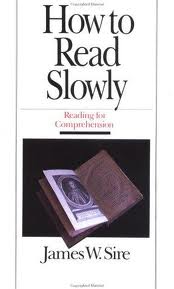
"How To Read Slowly"

How To Read Slowly by James W. Sire

I love this book! What's not to love in a book about reading? The authour's purpose is to help us read better for greater comprehension. He says "Our goal in reading carefully is not only to understand what is being said explicitly but to see why it is being said. We want to learn to recognize the world views of writers and speakers, and thus to know what their basic assumptions about life really are. It will help us decide what kind of attention to pay to their comments or proposals no matter how modest or immodest."

The second chapter deals with non-fiction, the next with poetry, then fiction and it wraps up with a chapter called "A Time To Read: Knowing What To Read and When". What I love about this book is that it leads you through reading exercises and explains point by point what to look for. Sire is a good teacher whose book, according to the publisher's blurb, "has been widely used in higher education classrooms to reach reading comprehension". I found myself underlining a lot of it because there is so much that is pertinent and helpful. I want to read it a few times and start applying its principles to my reading until it becomes second nature. Not that it's all new ideas; at one time or another you've probably heard most of it before, but if you're anything like me you've probably forgotten some of it too. This author has a clear and logical way of getting his ideas across that is both highly readable and very effective.

The chapter on poetry was fun. Sire quotes a few short poems and has us read them several times looking for specific things. As you follow his direction the poem begins to open up and you see more in it than you did on the previous reading. He compares understanding a poem to looking at blueprints to understand a building: "...and just as an architect or building engineers know what to look for when they examine the building, so do good readers." This is what he's teaching us: what to look for. He gets into metrical structure, image and sound structure, etc, but not deeply, just enough to help us unscramble the riddles poetry often presents. I found this the most interesting and practical chapter of the book.

In the chapter on fiction the topics of plot, character, theme, point of view, tone and style are looked at, again not in depth but enough to be helpful. He doesn't focus on any particular aspect of fiction but says "There is no point in paying close attention to details if we fail to experience the whole work and, as it were, to perceive it at a glance - to drink it in, savor it's succulent tastes and smells, feel its philosophy of life, see its vision of reality and come to grasp more fully what it means to be human.".

James Sire is a Christian and makes references to that throughout the book. He wants Christians to be better readers, more aware of what is going on in the world and what writers are saying about it. But whatever philosophy of life you hold to, this book is for any and all readers who want to get more out of what they read. As he puts it: "I don't expect any reader to imitate my own lifestyle nor to adopt point for point the precise values that I would at my best affirm. But I do want to announce at the beginning that I love reading and would like to help others love it too - and do it better."

I don't agree with everything Sire says and some of his comments seem a little stuffy but that's not hard to overlook when you consider how very useful his teaching is. I hope I haven't made it sound dry because it really isn't and at only 168 pages there isn't time to get too academic so it moves along and stays interesting. I expect this book to make a real difference in how I read. I recommend it to everyone.

"The Tears Of The Giraffe"

The Tears Of The Giraffe by Alexander McCall Smith
(Book 2 in The No.1 Ladies' Detective Agency series)

In the first book in this series we met Precious Ramotswe, an African woman who opens a detective agency in the small town of Gabarone, Botswana. She is a wonderful character, neither young or old, of "traditional build" (not-so-skinny), plainspoken, sensible and living by the moral code of " Old Africa" as her father had taught her.

Her detective skills are used this time to help a man who is worried his wife may be seeing someone else, and an American mother who is trying to find out what happened to her son when he disappeared in Africa ten years earlier.

In this volume the relationship between Mma Ramotswe and Mr. J.L.B. Matekoni continues to develop with the addition of two orphan children bringing a whole new dimension to their life as a couple. On the business side of things, Mma Ramotswe's secretary, Mma Makutsi begins to take a more prominent role in the story as she is promoted from secretary to "assistant detective".

I didn't enjoy this book as much as I did the first one, but can't quite put my finger on why, other than that Mr. J.L.B. Maketoni was referred to as Mr. J.L.B. Maketoni every single time he was mentioned. Even his fiance called him Mr. J.L.B. Maketoni. And there's something about the characters' way of communicating with each other that doesn't feel natural. It may be a cultural thing, but it seems like they are overly formal with each other, all the time.

I am enjoying what I'm learning about African life. It's all so completely foreign to me but that alone makes it interesting. I had wondered as I was reading why even the most ordinary of people seemed to have maids and was fascinated to read this: "It was a social duty to employ domestic staff, who were readily available and desperate for work. Wages were low - unconscionably so, thought Mma Ramotswe - but at least the system created jobs. If everybody with a job had a maid then that was food going into the mouths of the maids and their children. if everybody did their own housework and tended their own gardens, then what were the people who were maids and gardeners to do?" That's such a different mind-set than we hold in our society where we feel almost guilty about getting help. I have someone come in for an hour once a month to scrub my floors and after eight years I still feel uncomfortable about spending money on this luxury. I wish I could believe I was merely being a good citizen by paying someone else to do it for me.

Toward the end of the book, I came across a phrase I'd never heard before. Mma Ramotswe was pondering the moral dilemma of having to do a wrong thing to achieve a right thing and wishing her favorite detective magazine would make room for such discussions within it's pages so she could ask for advice. "Perhaps she could write to the editor anyway and suggest that an agony aunt be appointed; it would certainly make the journal very much more readable." What the heck is an agony aunt?

Turns out the definition of agony aunt is exactly what you would surmise from the above quote: "a newspaper columnist who gives advice to people having problems". I found all kinds of them online, mostly women but there are also "agony uncles" out there. Sometimes there is one name used , but with a team of people behind it giving advice in an "agony column". Dear Abby and Ann Landers are agony aunts. I feel rather silly now for not knowing that.

I have the next two books in the series on my shelves now so I'll read those and then decide if I want to go any further. Maybe I'll like the next one better; I had high hopes for this series and I'm not ready to give up on it just yet.
 

www.123lawsuitsloans.com