The Mill on the Floss

 The Mill on the Floss by George Eliot

This is the story of a young girl whose family suffers a loss of fortune and status, and how that affects her relationships and options in life. 

The writing of course is wonderful; I haven't read anything of Eliot's that I haven't loved. For this one I had an audio version, and it was great, but hearing it does not compare to reading it. With experience I've learned that for me audio is a good option for some books but not for all. Great writing needs to be read slowly, savored to absorb every rich sentence, and given enough attention to recognize when I've come to a passage worthy of underlining so I can find it again later. For that I need a printed book.

These are a few of my favourite quotes from The Mill on the Floss:

“Childhood has no forebodings; but then, it is soothed by no memories of outlived sorrow.”

“What novelty is worth that sweet monotony where everything is known and loved because it is known?” 

“No anguish I have had to bear on your account has been too heavy a price to pay for the new life into which I have entered in loving you.”

“There is something sustaining in the very agitation that accompanies the first shocks of trouble, just as an acute pain is often a stimulus, and produces an excitement which is transient strength. It is in the slow, changed life that follows--in the time when sorrow has become stale, and has no longer an emotive intensity that counteracts its pain--in the time when day follows day in dull unexpectant sameness, and trial is a dreary routine--it is then that despair threatens; it is then that the peremptory hunger of the soul is felt, and eye and ear are strained after some unlearned secret of our existence, which shall give to endurance the nature of satisfaction.” 

Wonderful, wonderful writing; her books are a gift to the world. I love Eliot, and I loved The Mill on the Floss.  

The Girl Who Saved The King of Sweden

 The Girl Who Saved The King of Sweden by Jonas Jonasson

Nombeko, 14 years old, intelligent and ambitious, works as a latrine cleaner in South Africa before becoming cleaning lady for, and prisoner of, a nuclear engineer working for the government. She spends years plotting her escape, using the time to learn the principals of nuclear science (because her boss is manufacturing bombs), and how to speak Chinese (because it's the native language of some of the other servant/prisoners).

As a servant she is ignored by most of the politicians and other influential visitors to her bosses office, but she observes and listens and files what she learns away for future use. When assigned the task of shipping a bomb to Israel, she uses the opportunity to escape, but then through a bureaucratic mix-up the bomb is sent to the wrong address and is delivered to Nombeko, herself when she settles in Sweden.

In Sweden she gets involved with a man named Holger and his brother, who is also named Holger and whose burning desire is to bring down the Swedish monarchy. The radical Holger's girlfriend shares his belief that the monarchy is corrupt and must be destroyed. The foursome have a series of unlikely adventures with an assortment of characters including Swedish and Chinese officials, Swedish royalty, and the girlfriend's flaky aunt who believes herself to be a Countess. Through all of this they cart the bomb around, trying to keep it hidden and looking for a way to be rid of it. 

It's a quirky story, full of improbable circumstances and coincidences that in the end make some kind of weird sense. It's fun and funny, but not weightless; you end up rooting for all these characters. I liked it. 


Murder on a Midnight Clear

 Murder on a Midnight Clear by Sara Rosett

A light-hearted mystery. The guests arriving at an English country manor for Christmas have secrets to keep, and they manage quite well until amateur sleuth, Olive, shows up. She wasn't meant to be a guest, but has followed her boyfriend, Jasper, there because his unexplained absences are becoming suspicious. Her snooping leads to a car accident near the manor, which results in her spending several days there to recover from a minor injury.  

A snow storm keeps her from leaving, which is just as well, because someone is reported missing and then found dead. The only thing anyone knows for sure is that the butler didn't do it, because the butler is it - the dead body, and it turns out he had secrets, too.

Jasper's original business at the manor is a bit of espionage that will be explained later in the book, and Olive's crime solving activities are common knowledge, so the Lord and Lady of the manor ask that they look into the murder before Scotland Yard arrives, which will be a couple of days because of the storm. Secrets, so many secrets, come to light in their sleuthing that the plot becomes quite thick indeed. It took me a minute to connect some of the dots, but that's what makes a good mystery a good mystery. 

This book lands somewhere in the middle of a series about Olive's investigating adventures but is the only one of them I've read. It was pretty good on its own; only Olive and Jasper's relationship might have been clearer to me if I'd read earlier books in the series. I enjoyed this one, but haven't decided yet if I'll read more of them.

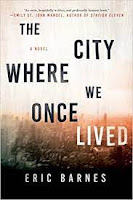
The City Where We Once Lived

The City Where We Once Lived by Eric Barnes

In the abandoned North End of a once thriving city, the narrator makes his home high up in an empty hotel suite. The few people who didn't move when climate change and urban decay sent most looking for a better life in the more prosperous South End, live quietly, satisfied that for now they still have water, electricity, and a little food. 

Nothing grows in the North End - all that was green is dry and brown - and rising water levels are swallowing more of it every week. The area, mostly empty, is no longer served by fire or police departments because the city considers it not worth any of its resources. People still come, some only to cause trouble, but some to escape their troubled lives elsewhere. All of this the narrator records in his notebook as he watches the deterioration continue around him. When a violent storm causes severe damage to both areas and crowds of people come from the South End to find shelter, a decision has to be made: let those people in or send them away. 

This is one of the better dystopian stories I've read. It's a little less dramatic than some in that there's been no global nuclear disaster, no deadly disease to wipe out most of the planet, just the gradual, seemingly now unstoppable effects of climate change. With infrastructure destroyed by brutal storms and rising water, people and businesses have been forced to abandon homes and office buildings and relocate. This is the story of one of the few to stay behind. 

A few chapters in I realized that none of the characters had been given names. The narrator is known as The Writer, another man as The Minister, others The Gardener, the Woman and the Boy, etc. I was uncomfortable with this at first, but in the end it works. I think I may have gotten to know them better without names. I felt so involved in their lives that when I wasn't reading, I missed them, and just writing this has given me the urge to read it again.

The writing is spare, the tone tense, and the characters unforgettable. I liked everything about it, especially the feeling of hope for humanity that it ends with.


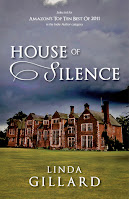
House of Silence

 House of Silence by Linda Gillard

Gwen Rowland, with no family after losing hers to alcohol, drugs, and aids, convinces her boyfriend, Alfie, to take her with him to his family Christmas gathering. He warns her she might be sorry she asked, but agrees and they head off to his family's slightly run down old country house. There she meets his four sisters and his mother, a famous author who stays in her bedroom unable to quite distinguish between the past and present. 

Gwen sees a change in Alfie once he is around his family and is a bit unsettled by how he treats them. When she finds and reads some old family letters, she realizes that something is not right. The family story she's been told appears to be a cover for things Alfie and his sisters don't want her to know. 

It's a  mystery/family saga/romance with lots of twists and turns and interesting characters. It maintains a good pace, moving perhaps a little too quickly in the latter part where the revelations all come out at once, but staying, if just barely, within the realm of credibility. After hurtling toward the end, it stops suddenly with everyone, including the reader, wondering what's next. In spite of that, maybe even a little because of it, it was a good read and one I recommend.

I just wish there was one more chapter.    

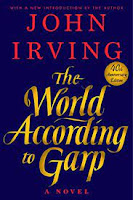
The World According To Garp / The Year of Magical Thinking

 The World According to Garp by John Irving

I started this a few years ago and gave up on it because I found it depressing. I remember I set it aside for a few days, then picked it up again only to find the next chapter starting with a kidnapping and rape. That was just too much, so even though I was three quarters of the way through and I'd never given up on a book after reading so much of it, I quit. A couple of weeks ago I was finishing up some of the books on my Guilt List, saw the dnf next to this one, and decided to try again. I did finish it this time, but can't say I enjoyed it. And yet there's something about it that I can't quite put my finger on. The overall tone, the funny with the tragic, was appealing in some way even while I wasn't liking what I was reading. In the end I was half glad I read it, and all glad I was done and could put it away.


The Year of Magical Thinking by Joan Didion
This is one of the best portrayals of grief I've ever encountered. I listened to an audio version performed by the incomparable Vanessa Redgrave, whose wonderful dramatization was so vivid and heartfelt I don't think I'll ever forget it. Even if you've already read the book, do listen to this. It's less than 2 hours long and very much worth your time. Heartbreaking, and absolutely beautiful.
 

www.123lawsuitsloans.com